Everyday maths activities hiding in one supermarket trip
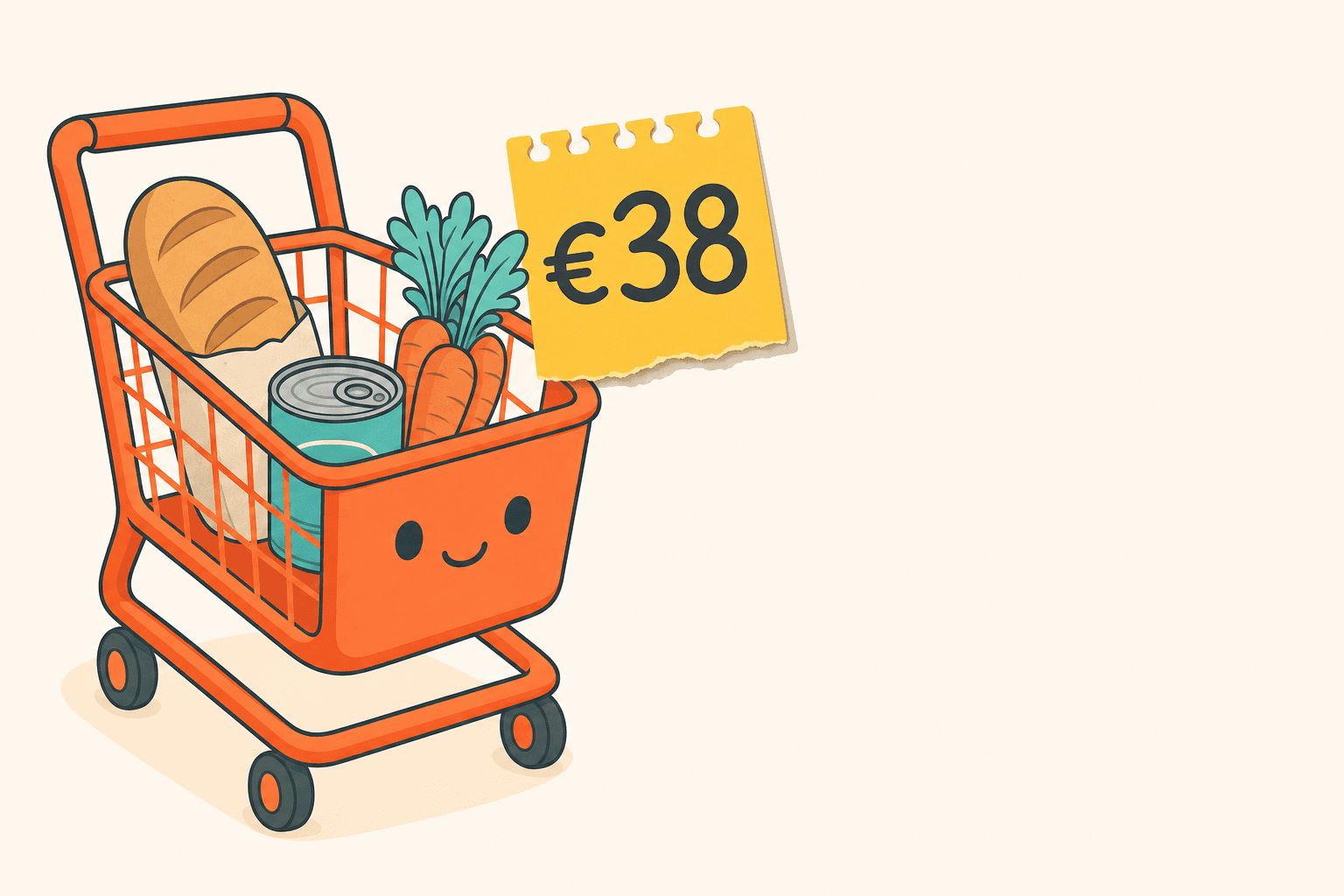
One shopping trip can hold a week's worth of everyday maths activities, from estimating a total to comparing prices and working out change.
In short
- Give your child the shopping list, a set budget and the authority to make real decisions — the maths only matters if the choices are theirs.
- Estimation beats exact arithmetic in a shop: a child who can say "about forty, not seventy" is reading numbers, not just processing them.
- Keep it to fifteen or twenty minutes, ask two or three good questions rather than twenty, and let wrong answers stay in the conversation.
Your child trails behind the trolley, bored, asking for the third time whether the biscuits can go in. Next time, try handing the trip over before you walk through the doors. Give them the list, name a budget, and tell them the job is keeping the total underneath it.
The chore stays a chore for you. For them it becomes twenty minutes of estimating, adding, comparing and deciding. This is one of the most useful everyday maths activities available to any family, and it needs no printouts, no planning and no extra slot in your week. You were going shopping anyway.
Hand over a real job, not a worksheet in disguise
Children spot a fake task immediately. If you ask them to add up the trolley while you quietly make every decision, they will do the sum without caring about the answer. The maths has to change something.
So give them the list, something to write on, and the right to make a call. Set the budget slightly tight — enough for everything on the list, with a little room, but not much. That small squeeze is what turns arithmetic into thinking.
Agree the rules before you start. If the trolley goes over budget, something comes out, and they choose what. If it comes in under, the difference goes toward one thing they pick. The stakes do not need to be big. They need to be real.
Estimation is the skill worth practising most
In a shop, nobody needs an exact running total. They need a good enough one, fast. That is a genuinely difficult skill and most maths homework never asks for it.
Teach the rounding out loud. An item priced at 2.89 becomes 3. One at 1.05 becomes 1. Your child carries a rough total in their head and updates it as items go in. At the till they find out how close they were.
Expect this to feel clumsy at first. Rounding up and down consistently, holding a number in your head while someone talks to you, adjusting when the total creeps — those are demanding jobs for a nine-year-old. They also transfer directly into exam-room number sense, where the fastest way to catch a wrong answer is knowing roughly what the right one should look like.
A child who can say "about forty, definitely not seventy" understands numbers better than one who can only reach for the exact answer.
Match the job to the age
The trip is the same. What you ask for changes.
Ages 6 to 8
Give them three or four items from the list, not twenty. Ask them to count out six apples, find the number on a shelf label, or say which of two packets costs more. Rounding to the nearest whole unit is plenty. The win here is noticing that numbers are printed everywhere and that they mean something.
Ages 9 to 11
Now they can carry a running total, handle prices with decimals, and work out how much is left in the budget. Introduce simple offers: a third off is roughly the same as taking away one item's price in three. If you pay in cash, let them work out the change before the cashier does.
Ages 12 to 13
This is where comparison shopping starts to bite. Cost per 100 grams. Whether a multi-buy is actually cheaper. Whether the larger pack wins once you account for the part that will be thrown away. If prices in your country are shown with tax included or excluded, that difference is worth a conversation of its own — it is a real-world reason to care about percentages.
Unit price is the best lesson in the aisle
The bigger box is usually cheaper per unit. Usually. Not always, and that exception is where the maths lives.
Stand in front of two sizes of the same product and ask your child which is better value. Then ask them to prove it. Divide the price by the weight or by the number of items and compare. Shelf labels in many shops print a price per unit somewhere in small text, which turns the task into checking rather than calculating — still useful, and quicker if you are short on time.
The follow-up question is the interesting one. Cheaper per unit is not the same as the better buy. If half of it spoils before you use it, the saving disappears. Let your child argue both sides. That is division, comparison and reasoning in one thirty-second exchange.
The checkout is where the maths gets marked
Before the first item is scanned, ask for the final estimate. Write it down. Then watch the total climb.
Landing within a small margin is a genuine achievement and worth saying so. Landing well over usually means one thing: they stopped updating after the halfway point. That is useful information, not a failure.
Afterwards, hand them the receipt. Ask them to find the most expensive line, the cheapest, and anything that came in higher than they expected. If you paid in cash, the change calculation is free practice you did not have to invent.
Keep it short, and do not do it every week
Fifteen to twenty minutes is the right length. Two or three good questions across a whole trip will do more than a running quiz that turns the shop into a test.
When a total comes out wrong, resist correcting it straight away. Ask how they got there. Half the time the arithmetic is fine and the mistake is a misread label. You learn more from the explanation than from the answer, and so do they.
Spacing matters too. Once every few weeks keeps it fresh. Every single trip turns it into homework with a trolley, which is exactly what you were trying to avoid.
Let it carry on into the kitchen
The bags coming through the door are the second half of the lesson, and it costs nothing.
Halving or doubling a recipe is fractions with an edible result. Dividing a pack of twelve fairly between five people raises remainders honestly. Sorting the shopping into groups is early classification work for younger children. Over a couple of months, comparing what you expected to spend with what you actually spent introduces the idea of a budget as something you track rather than something you guess once.
None of this needs to be announced as maths. It works better when it is not.
The maths a child remembers is usually the maths that decided something.
What you are really teaching
You are not adding a lesson to your week. You are showing your child that the numbers on the page belong to the world outside it — that estimating, comparing and deciding under a limit are things adults do constantly, and that they are allowed to be part of it.
Some trips will go badly. The total will be wildly out, someone will get bored in the third aisle, and you will finish the shop yourself. That is fine. The point is not a perfect calculation. It is a child who has started to look at a price tag and think, rather than just wait to be told.
Published 4 September 2026